Detector Hits + Oscillations 1 (Obsolete)
Demonstrate the total number of hits in the IceCube detector after implementaing neutrino oscillations.
This notebook uses files generated using the notebook detector_hits_file.
The progenitor model used is the Nakazato Shen model with z = 0.02, t\(_{rev}\) = 300ms, m = 13.0M\(_\odot\)
[1]:
from astropy import units as u
from astropy.table import Table

import numpy as np
import matplotlib as mpl
import matplotlib.pyplot as plt

from asteria import config, source, detector
from asteria.neutrino import Flavor

mpl.rc('font', size=18)
Prepare Iterables
Define the range of neutrino energies (E_nu) to simulate and the times (time) and distances (dist) at which to perform the simulation. The progenitor distance is set to 1 kpc.
[2]:
E_min = 0.1; E_max = 100.1; dE = 0.1;
Enu = np.arange(E_min, E_max, dE) * u.MeV

t_min = -1; t_max = 15; dt = 0.0001;
time = np.arange(t_min, t_max, dt) * u.s
Load Configuration
This will load the source configuration from a file.
For this to work, either the user needs to have done one of two things:
Run
python setup.py installin the ASTERIA directory.Run
python setup.py developand set the environment variableASTERIAto point to the git source checkout.
If these were not done, the initialization will fail because the paths will not be correctly resolved.
[3]:
conf = config.load_config('../../data/config/nakazato-shen-z0.02-t_rev300ms-s13.0.yaml')
ccsn = source.initialize(conf)
ic86 = detector.initialize(conf)
[4]:
icecube_dt = 2e-3 #s
deadtime = 0.25e-3
dc_rel_eff = 1.35

doms = ic86.doms_table()
n_i3_doms = len(doms[doms['type'] == 'i3'])
n_dc_doms = len(doms[doms['type'] == 'dc'])

i3_dom_bg_mu = 284.9
i3_dom_bg_sig = 26.2

dc_dom_bg_mu = 358.9;
dc_dom_bg_sig = 36.0;

i3_bg_mu  = 2933.72
i3_bg_sig = 85.8662
Define Helper Functions
hitsScale the original signalsignalcalculated for a progenitor at 1 kpc by the distancedistof the new progenitor, and use the new signal to generate and return detector hits for the given progenitor. The deadtime fractions used to generate hits are scaled by thetimebinbeing used.rebinReshape the independent variablevarwith resolutionold_binningand dependent variabledata(assumed to be numpy array) and return new arraysvaranddatawith resolutionnew_binning.backgroundUsetimebinto scale the mean background and the uncertainty, and return a randomly sampled array of lengthlen_array.
[5]:
def hits(signal, dist, timebin):
    total_signal = np.sum(signal, axis = 0) / dist**2
    eps_i3 = 0.87 / (1+deadtime* total_signal/timebin)
    eps_dc = 0.87 / (1+deadtime*total_signal*dc_rel_eff/timebin)
    hits = ic86.detector_hits(abs(total_signal), eps_i3, eps_dc)
    return hits
[6]:
def rebin(var, data, old_binning, new_binning):
    step = int(new_binning/old_binning)
    new_size = int(data.size / step)

    rebinned_data = np.sum(np.split( data, new_size ), axis=1)
    rebinned_var  = var.value[int(0.5 * step)::step]

    return rebinned_var, rebinned_data
[7]:
def background(timebin, len_array):
    # Calculating Background:
    dr  = (n_i3_doms*i3_dom_bg_mu + n_dc_doms*dc_dom_bg_mu ) * timebin;
    dr_er = np.sqrt((n_i3_doms*i3_dom_bg_sig**2 + n_dc_doms*dc_dom_bg_sig**2) * timebin)
    return np.random.normal(dr, dr_er, len_array)
Read Data from nakazato-shen-z0.02-t_rev300ms-s13.0_e_per_v.fits
[8]:
table = Table.read('nakazato-shen-z0.02-t_rev300ms-s13.0_e_per_v.fits')
[9]:
sig = np.asarray([table['unmixed nu_e sig'], table['unmixed nu_e_bar sig'], table['unmixed nu_x sig'], table['unmixed nu_x_bar sig']])
sig_norm = np.asarray([table['normal nu_e sig'], table['normal nu_e_bar sig'], table['normal nu_x sig'], table['normal nu_x_bar sig']])
sig_inv = np.asarray([table['inverted nu_e sig'], table['inverted nu_e_bar sig'], table['inverted nu_x sig'], table['inverted nu_x_bar sig']])
[11]:
# Scale signal to icecube_dt
sig_2ms = []
sig_norm_2ms = []
sig_inv_2ms = []
for i in range(len(Flavor)):
    time_2ms, sig_ = rebin(time, sig[i], dt, icecube_dt)
    time_2ms, sig_norm_ = rebin(time, sig_norm[i], dt, icecube_dt)
    time_2ms, sig_inv_ = rebin(time, sig_inv[i], dt, icecube_dt)
    sig_2ms.append(sig_)
    sig_norm_2ms.append(sig_norm_)
    sig_inv_2ms.append(sig_inv_)
Generate Plots
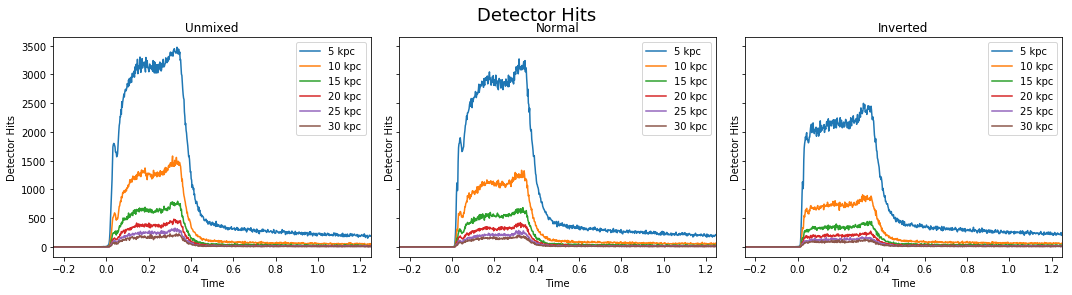
Hits vs time for various progenitor distances
[23]:
## Plotting nu_e_bar hits for each oscillation scenario
fig, axes = plt.subplots(1, 3, figsize = (15, 4), sharex = True, sharey = True)
ax1, ax2, ax3 = axes
fig.suptitle(r'Detector Hits', fontsize = 18, y = 1.015)
for d in range(5, 31, 5):
    new_hits = hits(sig_2ms, d, icecube_dt)
    hits_n = hits(sig_norm_2ms, d, icecube_dt)
    hits_i = hits(sig_inv_2ms, d, icecube_dt)

    ax1.plot(time_2ms, new_hits, label = '{0} kpc'.format(d))
    ax1.set(#xlim = (0, 0.1),
           xlabel = 'Time',
           ylabel = 'Detector Hits',
           title = 'Unmixed')
    ax1.legend()

    ax2.plot(time_2ms, hits_n, label = '{0} kpc'.format(d))
    ax2.set(xlim = (-0.25, 1.25),
           xlabel = 'Time',
           ylabel = 'Detector Hits',
           title = 'Normal')
    ax2.legend()

    ax3.plot(time_2ms, hits_i, label = '{0} kpc'.format(d))
    ax3.set(#xlim = (-0.25, 1.25),
           xlabel = 'Time',
           ylabel = 'Detector Hits',
           title = 'Inverted')
    ax3.legend()

fig.tight_layout()
# fig.subplots_adjust(top = 0.88)
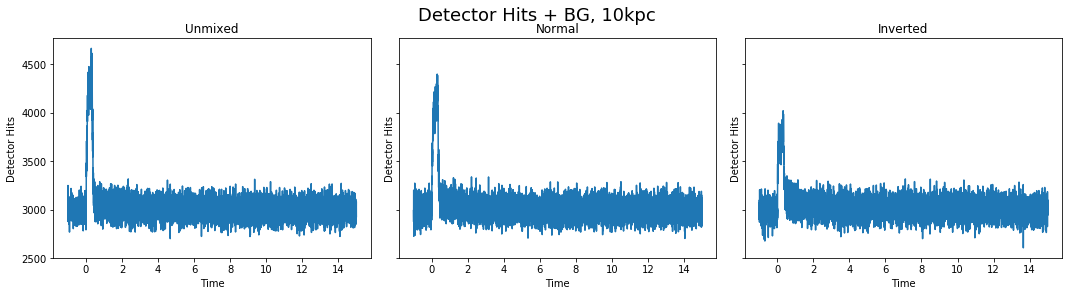
Hits + Backgroud for 10kpc
[24]:
fig, axes = plt.subplots(1, 3, figsize = (15, 4), sharex = True, sharey = True)
ax1, ax2, ax3 = axes
fig.suptitle(r'Detector Hits + BG, 10kpc', fontsize = 18, y = 1.017)
new_hits = hits(sig_2ms, 10, icecube_dt)
hits_n = hits(sig_norm_2ms, 10, icecube_dt)
hits_i = hits(sig_inv_2ms, 10, icecube_dt)

ax1.plot(time_2ms, new_hits + background(icecube_dt, len(time_2ms)))
ax1.set(#xlim = (0, 0.1),
       xlabel = 'Time',
       ylabel = 'Detector Hits',
       title = 'Unmixed')

ax2.plot(time_2ms, hits_n + background(icecube_dt, len(time_2ms)))
ax2.set(#xlim = (-0.25, 1.25),
       xlabel = 'Time',
       ylabel = 'Detector Hits',
       title = 'Normal')

ax3.plot(time_2ms, hits_i + background(icecube_dt, len(time_2ms)))
ax3.set(#xlim = (-0.25, 1.25),
       xlabel = 'Time',
       ylabel = 'Detector Hits',
       title = 'Inverted')

fig.tight_layout()
# fig.subplots_adjust(top = 0.88)
[ ]: